
What is the meaning of a grey and white mixed feather?
Short answer – finding a grey and white feather indicates needing to seek balance within ourselves or a message about seeking balance in all areas of our lives so we can confidently move forward towards achieving our targets.
Introduction
Feathers symbolize thought, dreaming, and spiritual freedom, with the color and type of feather offering more specific meanings.
Grey and white mixed feathers, in particular, have an even more extensive range of meanings as the combination requires further understanding of the unique colors and their significance.
We will talk about what grey and white combined feathers mean for those who find them.
Grey and White Mixed Feather – Spiritual Meanings:
Change
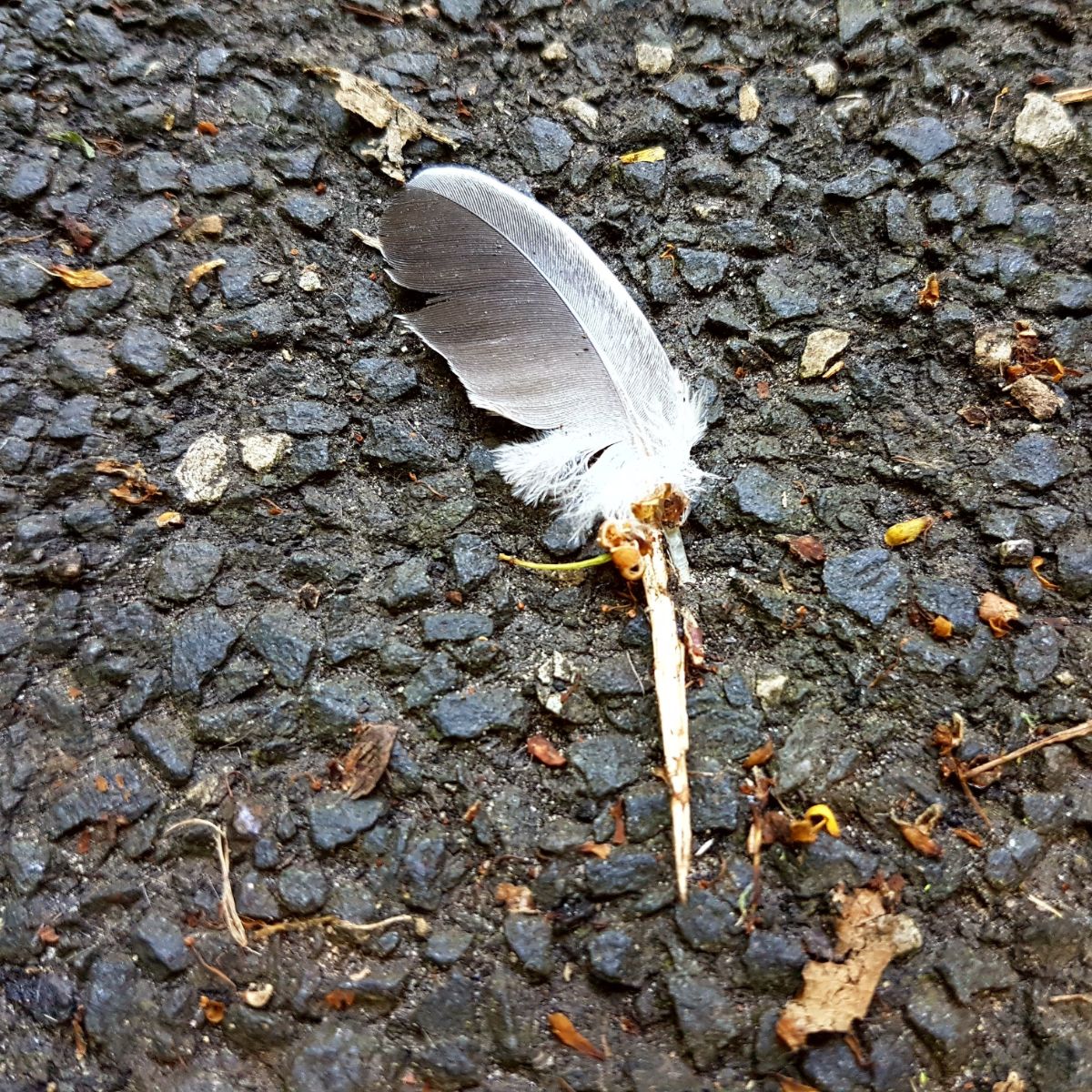
White itself is seen as a symbol of innocence and purity – a blank slate from which to begin anew.
Grey, on the other hand, represents a variety of subtle emotions, such as uncertainty or emotionless endurance. It also signifies an amalgamation between two extreme energies, black and white.
When viewed together, they can represent change without judgment – two extremes coming together in harmony or balance.
One must accept both the positive and negative aspects within oneself to pave the way for transformation or change.
As with any journey, there are good and bad days, times when you feel uplifted, and times when you feel weighed down by life’s struggles.
Grey symbolizes learning to sit within these conflicting forces without taking sides while striving towards your goal.
Insightful Fragments

When grey is combined with white – whether on a feather or otherwise – insight into one’s environment can be found, as well as a newfound realization about personal truths.
The contrast between dark and light conveys knowledge about self-development: being able to see what is hidden but not accepting it at face value but instead comprehending it so that you can use this information for personal growth.
We must first understand our obstacles before striving beyond them rather than simply trying to ignore them.
The mixed feather offers an opportunity for this type of insight, providing clarity where previously things may have felt muddy or confusing.
Spiritual Freedom
When interpreting the meaning behind any object found naturally in nature, we should consider how spiritually significant it might be.
Gray/white feathers suggest enlightenment obviously through its representation of balance.
However, this goes much deeper than mere physical appearance – they offer us liberation from confines based on societal expectations.
True spiritual freedom can be achieved, allowing us to live our lives according to our values rather than those imposed by society or others around us.
Emotionally Independent

The contrast between grey/white brings forth an emotionless or unbiased understanding of power dynamics – either internalized within ourselves or externalized outwards towards authority figures or other people in positions ‘above’ us – though we cannot simply do away with emotions altogether.
Instead, these feelings should be balanced out to make decisions more objectively rather than letting our feelings cloud our judgment.
Being able to control uncontrollable emotions gives us liberation from being puppets to our reactions leading us towards inner stability that leaves room for progress without being hindered by self-doubt or fear of failure.
Again, this is something offered by understanding the significance behind grey/white combinations like that seen on feathers found naturally in nature.
Momentous Occasions
A combination of black and white has apparent implications for situations where stark opposites are present, requiring reconciliation if peace is desired by all parties involved.
When interpreted from the perspective offered by a mix of gray/white – namely balance – important moments, such as weddings, become more meaningful, too, since the couples recognize each other’s differences while still unifying in love over commonalities shared by both partners, creating an atmosphere charged with excitement yet grounded firmly upon trustful devotion.
This momentous occasion becomes even more special when considering its symbolism thanks to a mixed feather, as each party must learn how best to work together despite the fact that challenges presented throughout their journey for mutual fulfillment resulting from their newfound companionship can exist comfortably within their relationship.
The Grey Feather: Between Light and Shadow

The color grey is usually overlooked, overshadowed by more vibrant colors. But there’s a quiet strength in its subtlety, a profound depth in its simplicity.
Grey is the middle ground, the color of compromise.
It doesn’t shout for attention; instead, it whispers, inviting those who listen to explore what lies between absolutes.
Imagine standing at the edge of daybreak, where night gives way to dawn.
The sky isn’t instantly awash with sunlight. Instead, there’s a period of grey twilight, an interlude where the world is neither fully cloaked in darkness nor bathed in light.
This is the essence of grey – the bridge between dualities, the mediator of extremes.
Grey feathers express this spirit of balance and equilibrium. They represent peace and tranquility, acting as a soothing balm to our chaotic lives. When we see a grey feather, we’re recalled of the importance of maintaining harmony within ourselves and with the world around us.
Grey is also a symbol of guidance and hope, particularly when found intermingled with white in a feather. The grey in these mixed feathers acts like a guiding light, cutting through the fog of uncertainty and illuminating the path forward.
Think of it as the silver lining in storm clouds.
Even in the middle of turmoil, the grey hints at the promise of brighter times ahead. It reassures us that no matter how difficult things may seem, we are never without guidance or hope.
Finding a grey and white feather can therefore be a reassuring experience. It’s proof that even when we find ourselves navigating the shadowy realms of life, we’re not alone.
There’s always a beacon shining, a silver thread weaving its way through our experiences, leading us to peace, balance, and, ultimately, the dawn of a new day.
ALSO READ: Left & Right Thumb Itching: meanings
Dream Symbolism
In dreams, feathers appear in various shades of black, white, and grey, but when a person dreams of a grey and white feather, it may symbolize a transition taking place within their life.
It is a sign of adaptability or the awareness of ambiguous situations, such as those found when making difficult decisions.
These dreams also signify indecisiveness or ambivalence when it comes to certain situations.
For instance, if you’ve been attempting to decide between two jobs or partners but aren’t sure which is right for you, this dream may be pointing out your inner conflict while encouraging you to take action to discover what best fits your gut instinct.
ALSO READ: What is the spiritual meaning of Valentine’s Day?
Grey and White Mixed Feather Meaning in the Bible

In the Bible, grey and white feathers carry significant symbolism. They typically represent purity or divinity, with numerous passages throughout the text reflecting this association.
Grey and white mixed feathers are thought to be signs from angels indicating their presence. This type of feather symbolizes peace, harmony, and balance. The grey feather specifically is a sign of tranquility, peace, and calmness, but it also carries the symbol of hope.
A white feather represents peace and purity, while a grey feather can signify wisdom and guidance. Christian mythology has it that angels would send a grey and white feather just before making their presence known.
These feathers are believed to signify good luck. According to Bible, no matter how far we fall into sin or doubt, God will forgive us, and this is represented by the grey and white feather.
Show the white feather
English has a harsh idiom about white feathers, and it hatched in Georgian cockpits.
Lexicographer Francis Grose (a compiler of dictionaries for slang and street talk) printed the phrase in 1785: a cock with a white feather “is not of the true game breed”. Brewer’s Dictionary of Phrase and Fable, revised in 1895, says flatly “No gamecock has a white feather” (Brewer, 1895), because a pale plume in a dark tail betrayed a cross-breed, and breeders expected a mixed bird to flinch in the pit.
Pretty rough on the chicken, I think. Two most common readings of a grey and white feather today are calm and balance. Somewhere in two hundred years, a pale streak went from proof of bad blood to a note from heaven, at least for most of people who search the phrase.
Folkestone, August 1914
On the thirtieth of August, 1914, Admiral Charles Penrose Fitzgerald (1841-1921) recruited thirty women in Folkestone to hand white feathers to men out of uniform. Newspapers reported it. The habit spread nationwid.
Soldiers disliked it, and with reason: men home on leave got feathers, and so did volunteers the army had refused on medical grounds (in Australia, those rejected men formed a Rejected Volunteers’ Association and wore a badge to prove they had tried).
A. E. W. Mason had put this exact shame into fiction twelve years before.
In The Four Feathers (1902), Harry resigns his commission the day before his regiment leaves for Sudan, three fellow officers and his fiancée each send him a white feather, he sails to Sudan, and he puts on an Arab disguise to win back his name, a plot that has fed at least seven films.
In the United States the symbol flipped. Gunnery Sergeant Carlos Hathcock, a Marine sniper in Vietnam, wore white feather in his hat to taunt enemy troops and received a Silver Star for bravery. So which is it, coward or hero?
Parihaka
In the 1870s the Māori prophet Te Whiti o Rongomai, who preached passive resistance, had his followers at Parihaka wear white feathers. Iwi from that area still wear them, and so does Te Āti Awa in Wellington.
They call the feather te raukura. Word for word that means “the red feather”, though the sense is closer to a chiefly plume. Albatross feathers are preferred, though any white one will do. People wear it in the hair or on a lapel, never hung from the ear.
Back in Britain, pacifists reclaimed the symbol as well: in 1937 the Peace Pledge Union sold five hundred white feather badges.
Weighed against a heart
Egyptian judgment scenes put a dead person’s heart on one pan of a scale and a single ostrich feather on the other. That feather belonged to Ma’at, goddess of truth and order, and a heart heavier than it went to Ammit, a devourer who waits by the scale. The Papyrus of Ani (around 1250 BCE, now in the British Museum) shows the scene.
Spell 125, the text these pictures go with, never mentions a heart on a scale (that one surprised me). It lists sins the dead person swears off, one by one.
I tracked where a pale feather appears in history, from a 1785 dictionary to a 1937 peace badge, and noted what each setting made of it.
| Setting | What the feather meant | Source of the belief |
|---|---|---|
| Georgian cockpit | A cross-bred, timid bird | Grose’s 1785 dictionary |
| Egyptian judgment scene | truth, weighed against a heart | Book of the Dead, Spell 125 |
| Folkestone street, 1914 | the charge of cowardice | Admiral Fitzgerald’s campaign |
| Parihaka, 1870s | peace, worn in the hair | Te Whiti o Rongomai |
| Psalm 91:4 | “cover thee with his feathers” | King James Bible |
| Mason’s 1902 novel | shame that sends Harry to Sudan | The Four Feathers |
| Vietnam, a Marine’s hat | Courage, or a dare? | Carlos Hathcock |
| A dream of a mixed feather | change on its way | modern dream interpretation |
| Peace Pledge Union, 1937 | a badge against war | British pacifists |
| Angel lore today | “an angel is near” | present-day angel writers |
Græg
Grey comes from Old English græg, which Etymonline defines as a color between white and black, with little or no luminosity. Chaucer wrote of a woman with eyes “grey as glas”, and Old English glossaries matched græg with Latin glaucus.
Americans spell it gray. Greyhound has nothing to do with the color at all: its first half comes from an Old Norse word for a female dog.
What I do when I find one
First thing I do is a photo, close up, with my thumb in frame for scale. After that I note the place and the hour, because a feather in a hospital car park mean something different to me than one on a forest trail.
A native bird’s feather stays on the ground. A pigeon feather comes home in my coat pocket.
At home I ask myself one question: where in my life am I stuck between two extremes right now? Of all the meanings in the sections up top, balance is the only one I take personally, and some nights I add Psalm 91:4 in the King James Version, “He shall cover thee with his feathers, and under his wings shalt thou trust: his truth shall be thy shield and buckler” (KJV, Psalm 91:4).
Final Thoughts
Finding a grey/white mixed feather promotes enlightenment through recognizing balance created through conflicting energies – be they internal or external.

This brings us closer to achieving spiritual freedom leading down paths traversed traditionally only by individuals brave enough to follow their gut instinct. Their instinct is backed up with impartial understanding derived using insights via contemplation.
By applying this message, we come closer to reaching profound realizations enabling us to create momentous occasions using our imagination and excitingly paving new ways ahead filled with potential.
ALSO READ: Spiritual Meaning of Double Rainbow
- About the Author
- Latest Posts
John McDonald is a writer living in South Dakota. John is a seeker of truth and knowledge, exploring both ancient and modern information to help find the interconnectedness of the two. He has noticed universal synchronicities from an early age which he uses to gain insight into life’s spiritual symbolism. When John isn’t writing, he enjoys spending time outdoors, going on hikes or to the movies, and trying out new vegan recipes.