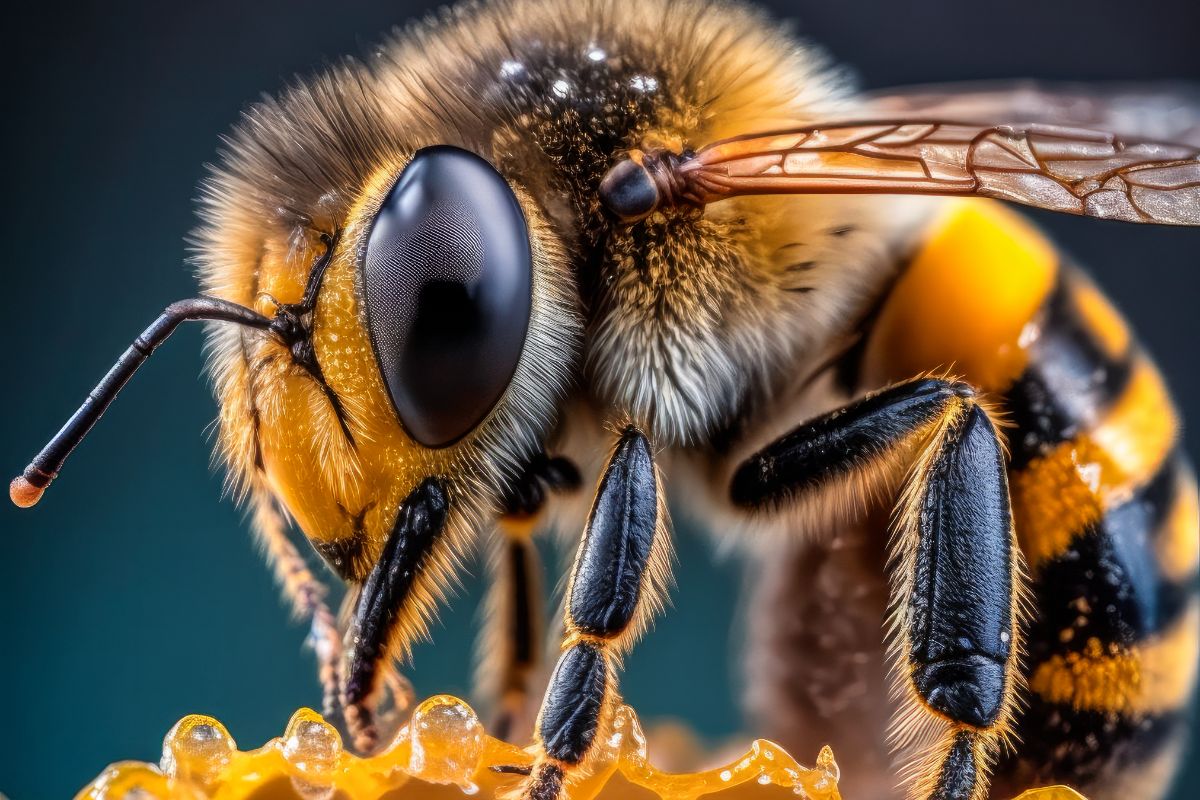
What is the spiritual meaning of bee pollen?
Introduction
In the hustle and bustle of our everyday lives, we commonly miss the profound wisdom embedded in nature’s most straightforward offerings.
One such marvel is bee pollen – a tiny grain that holds within it not just the promise of life but also deep spiritual meaning.
As an experienced writer who has spent a decade diving deep into the mysteries of life, I invite you to join me on this fascinating journey into the spiritual world of bee pollen.
Before we get into the symbolism of bee pollen, there are some interesting facts about bee pollen that you should know.
Bee Pollen – Facts
Bee pollen is a by-product of the honey-making process.
Worker bees collect pollen from flowers, mix it with their saliva to form tiny granules, and carry them back to the hive.
These granules are then packed into the cells of the honeycomb, where they ferment into what we know as bee pollen. This process preserves the nutritional value of the pollen, making it a potent superfood.
Bee pollen is a nutritional powerhouse. It contains around 250 substances, including vitamins, minerals, amino acids, antioxidants, and enzymes.
It’s rich in protein, with more than half of it in the form of free amino acids that can be directly absorbed by the body.
Bee pollen also contains B-complex vitamins, vitamin C, and carotenoids, which are vital for overall health.
The Symbolism of Bees and Pollination
Bees, in many cultures, symbolize fertility, community, prosperity, diligence, and resurrection.
Their daily routine of pollination mirrors the cycle of life, death, and rebirth, and stands as a powerful metaphor for spiritual metamorphosis.
As bees spread the pollen from flower to flower, they facilitate the birth of new life, echoing the spiritual concept of karma and the interconnectedness of all beings.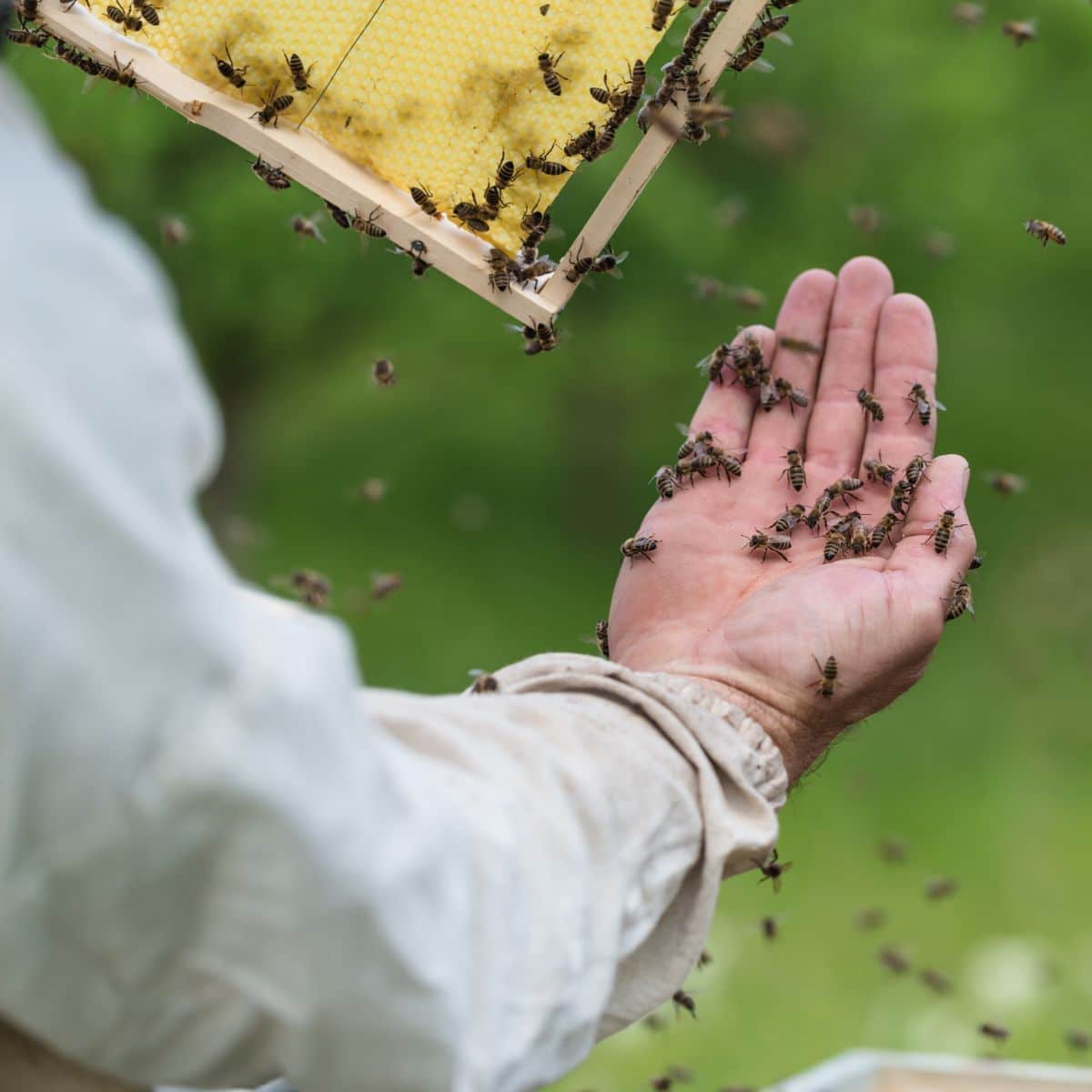
Bee Pollen – Spiritual Meanings:
The Elixir of Life
Bee pollen, this tiny yet powerful entity, holds a monumental secret within its minuscule granules.
This secret, usually overlooked in the hustle and bustle of our daily lives, is its representation as the elixir of life – an embodiment of vitality, longevity, and divine nourishment.
In many cultures and spiritual traditions around the world, the elixir of life is a revered concept.
It is viewed as a divine nectar, a potion that bestows upon the consumer a life filled with energy, vitality, and longevity.
It is this very essence that bee pollen encapsulates.
Each grain of pollen is full of nutrients, packed with proteins, vitamins, and minerals that are essential for our physical health and well-being.
Similar to the mythical elixir of life that promises to sustain and extend life, bee pollen nourishes our bodies, supporting our health and promoting longevity.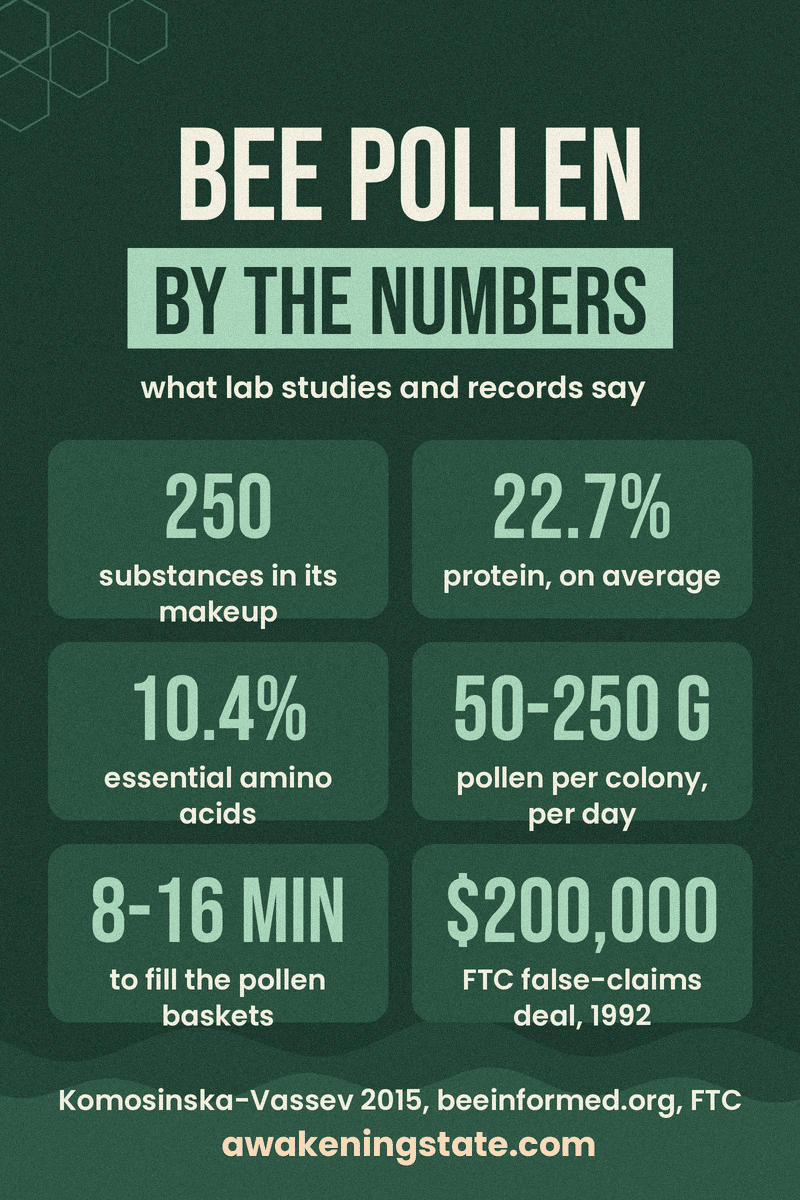
But the parallels between bee pollen and the elixir of life extend beyond the physical realm.
They venture into the spiritual domain, where the nourishment of the soul takes precedence over the nourishment of the body.
Just as bee pollen fuels our bodies, spiritual growth nourishes our souls. It gives us the strength and resilience to navigate life’s challenges, fostering inner vitality and spiritual longevity.
Spiritual growth, like the intake of bee pollen, is a continuous process.
It requires consistent nurturing and care.
As we delve deeper into spiritual practices, we begin to unveil layers of understanding, wisdom, and connection that invigorate our spirits.
This process breathes life into our existence, much like the elixir of life is believed to do.
The Lesson of Symbiosis
Nature has an interesting way of teaching us life lessons, and the relationship between bees and flowers is no exception.
This relationship is a beautiful dance of symbiosis, an intricate ballet of give-and-take that benefits both parties involved.
It is a silent yet powerful lesson on reciprocity, a principle deeply ingrained in spirituality.
In the grand scheme of nature, bees and flowers are interdependent.
Bees collect pollen from flowers, nourishing their hive and ensuring the survival of their species.
In return, they facilitate the pollination of flowers, playing a crucial role in the reproduction of plant species.
This mutual exchange forms a perfect circle of life, where each party contributes to and benefits from the other’s existence.
This symbiotic relationship mirrors the principle of reciprocity in spirituality.
In our spiritual journey, we are both receivers and givers.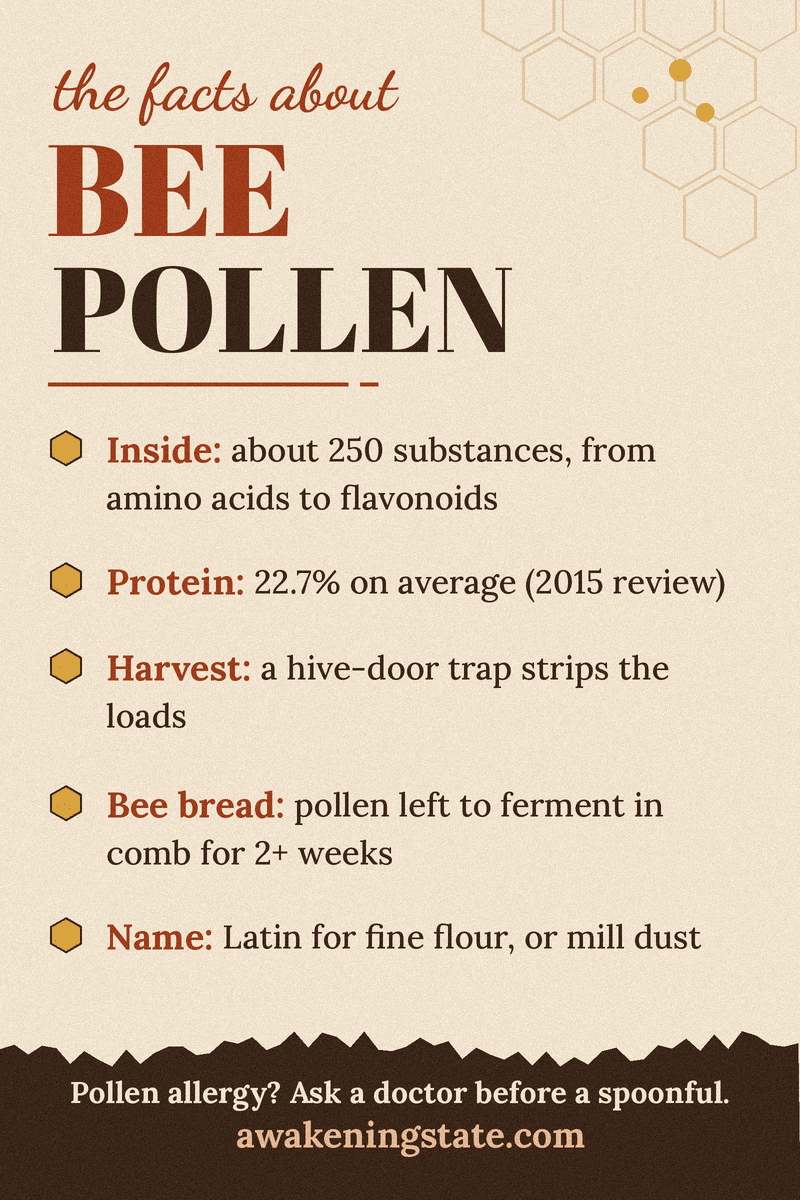
We receive wisdom, love, and enlightenment from the universe, our experiences, and those around us.
Simultaneously, we are called upon to share these gifts, to spread the light we have received, and to contribute positively to the world around us.
Spiritual growth is not a solitary endeavor.
It is a shared journey, where the wisdom we gain is not meant to be hoarded but shared with others.
Like bees collect pollen for their hive and not for themselves alone, we are also meant to disseminate the wisdom we acquire.
This sharing does not deplete our spiritual wealth; instead, it amplifies it. The more we give, the more we receive.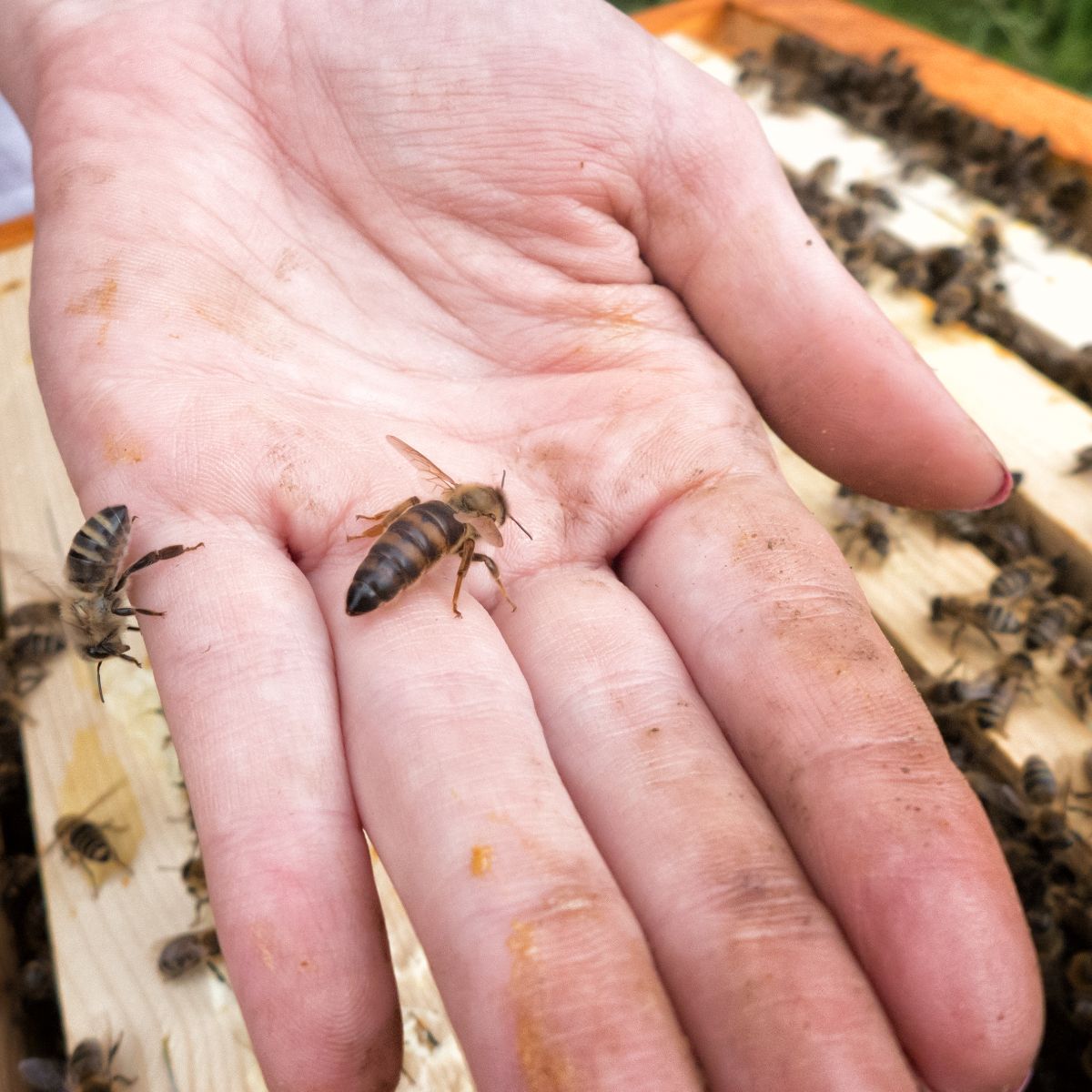
The Colors of Bee Pollen: A Palette of Diversity
Bee pollen, a remarkable product of nature’s design, is a vibrant testament to the diversity and beauty of our natural world.
A single glance at a collection of bee pollen reveals a stunning palette of colors, each as unique and intriguing as the flower from which it originated.
This colorful array not only adds aesthetic appeal but also carries significant implications for both the physical and spiritual realms.
Each granule of bee pollen encapsulates the very essence of a flower, its color reflecting the plant’s unique characteristics and properties.
Ranging from the sunny yellows of dandelions and sunflowers to the deep reds of roses, from the soothing greens of buckwheat to the mysterious greys of borage, the colors of bee pollen paint a vivid picture of the floral diversity that our planet boasts.
Much like a painter uses different colors to bring a canvas to life, nature uses the varied hues of bee pollen to create a dynamic and ever-changing landscape.
Each color signifies a different plant species, each with its unique rhythm and life cycle. The changing colors of bee pollen throughout the seasons mark the ebb and flow of life, mirroring the cyclical nature of our lives.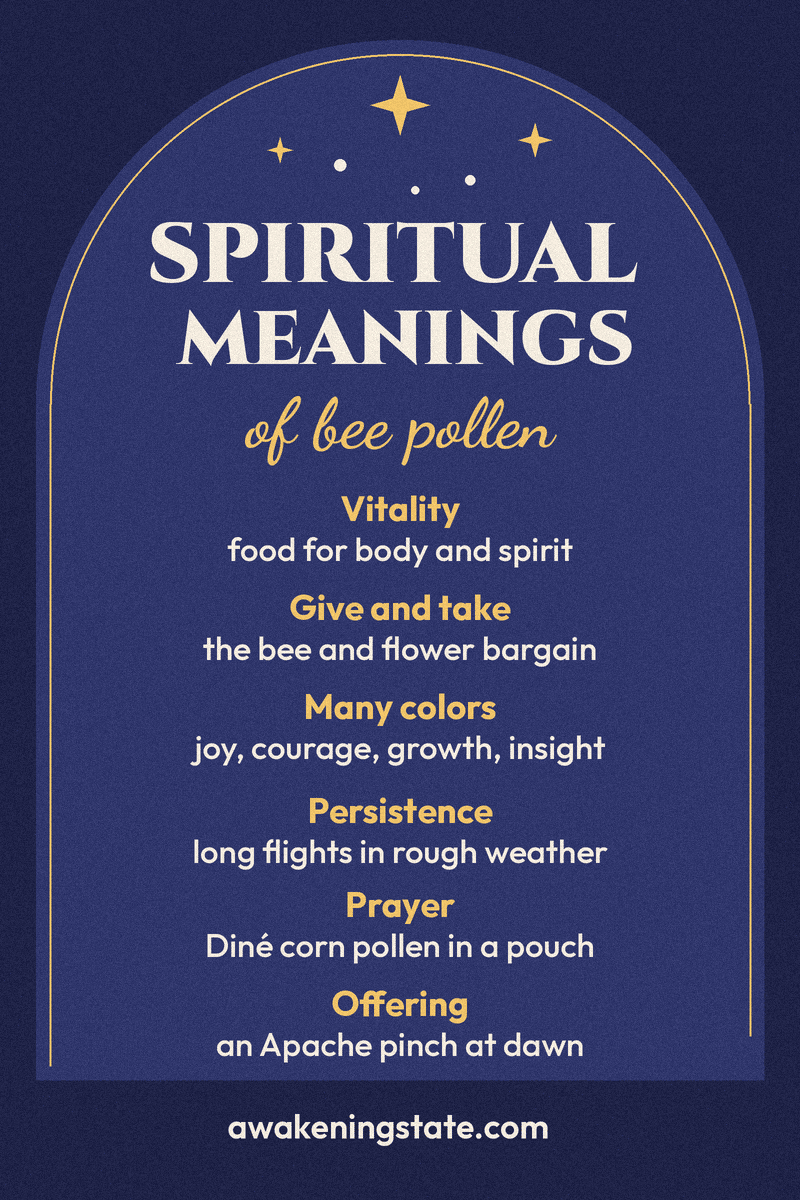
On a deeper level, the varied colors of bee pollen also hold spiritual significance.
In many cultures, colors are seen as symbolic, carrying specific meanings and energies.
For instance, yellow, the most common color of bee pollen, is associated with joy, vitality, and intellectual energy.
Red symbolizes passion and courage, while green stands for healing and growth. Even the rare blue and purple pollens carry the vibrations of intuition and spiritual insight.
As such, the diverse colors of bee pollen can act as a spiritual tool, reminding us of the different energies we carry within us.
They invite us to celebrate our multifaceted nature, encouraging us to entwine all aspects of our being – the intellectual, the passionate, the intuitive, and the restorative.
Toughness: Lessons from the Hive
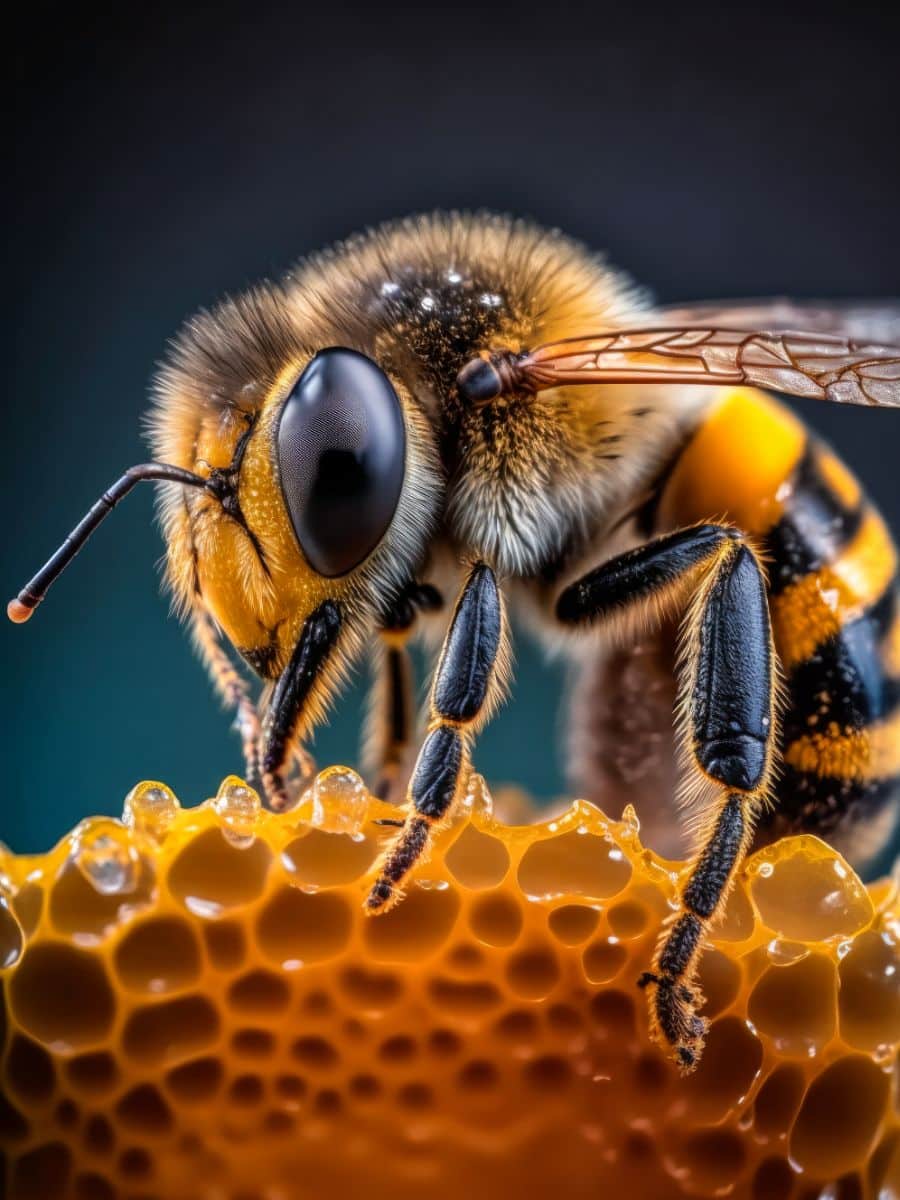
In the buzzing world of bees, the creation of bee pollen is a testament to toughness and determination.
From the moment a bee lands on a flower to the time the pollen reaches the hive, the journey is fraught with challenges.
Harsh weather conditions, predators, and long distances are but a few obstacles that these tiny winged insects must overcome. However, they persist, driven by an unwavering commitment to their mission.
The resulting bee pollen is not just a nutrient-rich food source but a symbol of toughness, a lesson in tenacity etched in nature’s narrative.
The spiritual journey we cover is no different. We face numerous challenges on our path to spiritual enlightenment.
These challenges can take the form of internal struggles, such as doubts, fears, and negative emotions, or external obstacles, like societal pressures and life circumstances.
They test our mettle, question our faith, and often make us question the path we have chosen.
However, much like the bees that continue their quest for pollen despite the odds, we are called to persevere in our spiritual journey.
Each challenge we encounter and overcome strengthens our spirit, deepens our understanding, and brings us a step closer to enlightenment.
Wax on its legs, said Aristotle
Aristotle (384-322 BC) watched foragers fly home with fat yellow lumps on their hind legs and decided that most of cargo was wax. He knew of a second food, though.
In his History of Animals he calls it bee-bread and writes that it “is scarcer than honey and has a sweet figlike taste” (Thompson translation).
Pliny the Elder (AD 23-79) disagreed about the taste. Book 11 of his Natural History names the stuff erithace (some Romans said sandaraca) and reports it in comb cells, “being of a bitter flavour also” (Project Gutenberg).
Sweet or bitter?
Pollen packed into a cell ferments for at least two weeks (lactic acid bacteria do that work, per a 2023 lab study in Biomolecules), and the finished bee-bread is more acidic than fresh pollen, so a spoon from a new cell and a spoon from an aged comb are two different foods.
Latin pollen meant mill dust, the fine flour that drifts off a grindstone. English used the word for a flour from the 1520s, and botany adopted it in 1760, after Linnaeus.
Hoddentin at dawn
John G. Bourke (1846-1896) was a cavalry captain with a notebook habit.
His 1892 report for the Bureau of Ethnology devotes a whole chapter to hoddentin, which he translates as “the powder or pollen of the tule,” a marsh reed.
After long marches, Apache men would “put a pinch of hoddentin on their tongues as a restorative,” he wrote.
One informant told him: “Our custom is to throw a very small pinch of hoddentin at dawn.” Girls at puberty fasted a whole day and tossed it to the sun. Medicine-men scattered pinches over young corn.
Diné (Navajo) families store tádídíín, yellow pollen from corn tassels, in small leather pouches and offer it in prayer (University of New Mexico).
In the Quran, bees get a whole surah. An-Nahl, “The Bee,” is the sixteenth, and its verse 69 speaks of “a drink, varying in colors, in which there is healing for people” (Quran 16:69, Sahih International, Quran.com).
Ibn Kathir explained those colors as white, yellow, red or other good colors of honey, a shade for whatever the bees ate. That gloss would fit snugly into the colors section two sections up.
| Where it shows up | What people do or say | Source |
|---|---|---|
| Apache trail | a pinch on weary tongues | Bourke, 1892 |
| Latin mills | “mill dust” | Etymonline |
| Diné prayer | pollen from leather pouches | University of New Mexico notes |
| Surah An-Nahl | which colors heal? | verse 16:69 |
| Apache puberty rite | girls toss it sunward | Bourke’s field notes |
| Greek apiaries | “sweet figlike” bee-bread | Aristotle, History of Animals |
| Phoenix TV ads | the promise of zero allergy | FTC case, 1992 |
| Roman combs | a bitter worker food | Pliny, Book 11 |
Who sold it as a cure-all?
Superfood talk arrived much later. In December 1992 the Federal Trade Commission announced that CC Pollen Company of Phoenix and its principals, Royden Brown named with them, agreed to pay two hundred thousand dollars to settle charges of false health claims (FTC release). Weight loss was one. Another ad line said bee pollen “cannot result in an allergic reaction,” and some spots ran as infomercials dressed up as news shows.
I failed to find any early text that calls pollen an elixir of life. No joke, a cavalry captain’s notebook comes closest.
Jars on shop shelves come from a pollen trap, a grid at the hive door that knock the loads off each corbicula (the pollen basket on a worker’s hind leg) as foragers squeeze through (Bee Culture). Fresh grains are ten to twelve percent water. Dried, they lose most of it’s moisture, down to about four percent. I doubt most of people who sprinkle it on oatmeal have seen a trap.
Final Thoughts
The spiritual significance of bee pollen is a testament to the subtle lessons that nature offers us if we only take the time to observe and listen.
It invites us to grasp the values of diligence, reciprocity, and diversity, guiding us on our spiritual journey.
As we go about our busy lives, let us remember the humble bee, diligently collecting grains of pollen, and find inspiration in its simple as well as profound act of service to life.
READ THIS NEXT:
The Spiritual Meaning of Being Stung by a Bee in a Dream
What does it mean spiritually when you see a vulture?
What Does the Bible Say About “Signs” from God?
Getting Stung by a Bee Spiritual Meaning
Why Do Bees Follow Me Spiritual Meaning
- About the Author
- Latest Posts
Irina is a co-founder and author at AwakeningState.com, an online magazine launched in 2016 that aims to expand consciousness every day. Offering eye-opening articles on a range of topics, Irina strives to provide unique insights into personal growth, covering areas such as spiritual awakening, health, lifestyle, nature, and science.